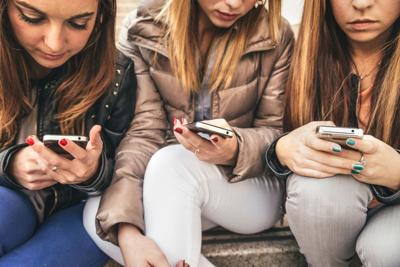



Photo provided by DepositPhotos
State lawmakers have spent the past three years in rare agreement. As of February 2026, 32 states ban or limit cellphone use in K-12 classrooms, according to Ballotpedia's policy tracker, and 41 have enacted some law or policy on the issue. The movement started with Florida in 2023 and accelerated fast: 22 of those laws passed in 2025 alone. Few education policies move that quickly, and fewer still attract sponsors from both parties.
Every one of those laws shares a boundary, though. They govern the school day. The moment a student walks out the door, the policy expires, and the phone comes back out right as homework begins. The question the legislative wave left open: What happens to focus during the hours no law touches?
Teens Field 237 Notifications a Day, and Most Arrive Outside School Hours
People are also reading…
Common Sense Media tracked actual smartphone data from roughly 200 teens for its Constant Companion report and found that over half of participants received 237 or more notifications per day. Only about 23% of those arrived during school hours.
Roughly three-quarters of the barrage lands outside the school day, in the evening and overnight stretches when homework gets done. The same report found teens picked up their phones an average of more than 100 times a day, and over two-thirds of 11- to 17-year-olds admitted they sometimes or often find it hard to stop using technology.
The data points to a pattern lawmakers didn't legislate for: The classroom was never the loudest part of a teen's day. The kitchen table is.
The Bans Work Because an Adult Runs the System
The design of the laws makes the pattern sharper. Per Education Week's coverage of the state policies, most require districts to adopt rules meeting state parameters, and many of those rules require phones to be stored or locked away, some from first bell to last.
All of that shares one feature. A teacher collects the phone and an administrator sets the schedule. The student's willpower is never the load-bearing wall.
Homework flips that arrangement. The student becomes the sole enforcer of a rule nobody wrote, working against a device built to interrupt. One hundred daily pickups against one tired teenager is not a fair fight.
Timed Study Blocks Do at Home What the Bans Do at School
The fix borrows the thing that makes the school-day rules work: a bounded, single-task window with a clear start and stop.
That's the logic behind timeboxing methods like the Pomodoro technique, which splits study time into short focused intervals separated by scheduled breaks. The interval acts as a container. The phone has a designated off period, the break has a designated on period, and the student stops relitigating the decision every ninety seconds. It's the closest thing to a bell-to-bell policy a bedroom desk can offer.
Parents can reinforce the container without playing hall monitor. Notifications go off during the interval and the phone sits in another room until the scheduled break. The structure does the enforcing, which was the whole point of the classroom bans anyway.
The Next Phase of the Phone Debate Is Unsupervised Hours
The legislative wave settled the supervised half of the problem and exposed the unsupervised half. Schools now have a system. Homes mostly don't, and the notification data suggests that's where the volume actually is.
The policy wave is still landing, too. Michigan's classroom ban, signed in February 2026, doesn't take effect until the 2026-27 school year, and several state deadlines for district policies run into 2026. As those rules settle in and districts start reporting results, the follow-up question shifts to families: what students do at 7 p.m. was never on the ballot, and it's the part of the day the numbers say is loudest.