


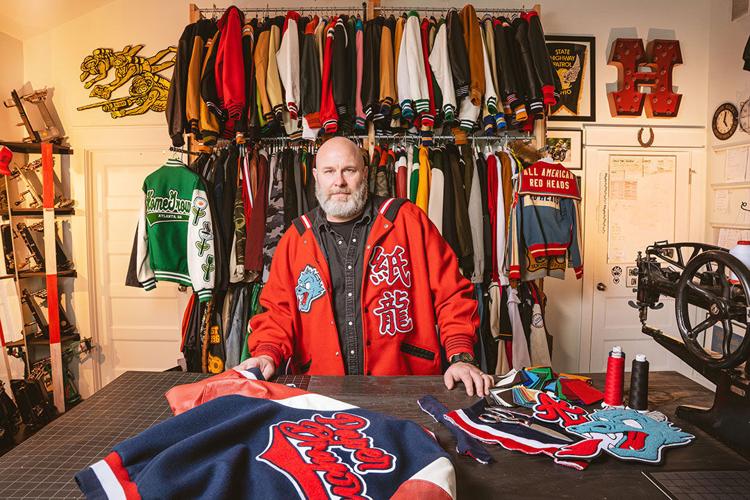
From sculpting wood and designing powerplant control rooms to stitching high-end fashion, creative authenticity has guided Huckleberry Starnes ’03 every step of the way.
If there’s one constant to Huckleberry Starnes’ career — and there aren’t many — it’s the need for personal expression. Whether it was making Claymation cutscenes for the videogame “Laser Lords” while in high school, or designing control rooms for nuclear power plants around the country, Starnes’ pursuit of creative freedom has led the way.
For the past six years, he’s channeled that passion into his custom garment and embroidery business Huckmade, creating one-of-a-kind items for celebrities like Usher, companies like Adidas and the Netflix series “The Boroughs.” Though fun and fulfilling, his multiple reinventions and experiences have pushed him beyond the typical artist or businessman.
People are also reading…
“I tell people all the time, it’s such a crackpot idea to run a business based on a 100-year-old embroidery machine,” said Starnes. “It’s not only about your technique, but the time you invest in learning how to run it, and then also how you run your business and how you communicate.”
Carving out a career
A Dayton, Ohio, native, Starnes graduated from the Rhode Island School of Design in 1994 as a sculpture major and came to Atlanta — ostensibly to build a log cabin for a client — but when that fell through, he carved out a living as an artisanal carpenter.
Characterizing those early days as “feast or famine” — he made his first woodworking commission without any tools of his own — Starnes created Huckmade as a successful woodworking atelier, but recognized the uncertainty and instability of a do-it-yourself career.
“I loved being a woodworker, but I didn’t know what the future was in that. Industrial design was a second passion of mine [at RISD], and it seemed like that offered a more professional career while still making stuff, which is what my passion is.”
Finding a professor who can guide you through your experience is so important.
Aspiring to be a toy designer for Hasbro, Auburn University offered the training and accreditation he sought to grow his career, while also being close enough to continue his woodworking business, which paid his tuition.
To acquire the master’s in industrial design he sought, Starnes first earned a 2003 bachelor’s in environmental design through Auburn’s post-baccalaureate program, designed for experienced students seeking a second degree, then began writing his thesis on action figure design.
Starnes credits his success at Auburn to the influence of his thesis advisor, Graduate Program Officer and PlayCore Professor Tin-Man Lau, who helped imbue a professional education into his past hands-on experiences. Starnes later studied with Lau on Auburn Industrial Designs’ first exchange program to Taiwan.
“Finding a professor who can guide you through your experience is so important. [Lau] was really instrumental in guiding me through the program, and I think it would have been a much different experience if I didn’t have somebody like him to really connect with.”
In 2004, industrial design master’s in hand but no offer from Hasbro, Starnes joined industrial furniture company Technical Interiors (now Winsted). Soon he was helping design spaces for the Stennis Space Center, Lockheed Martin, half of all U.S. nuclear power plants control rooms, and the security console template for every Smithsonian property worldwide.
“That [Smithsonian] job was kind of like winning the Super Bowl. At that point, I was ready to move on to something else.”
Fashion forward
What began as a hobby during the COVID-19 pandemic to make an authentic, 1950s-era bowling shirt led to Huckmade’s second life as a clothing brand of customized patches, jerseys, varsity jackets and more.
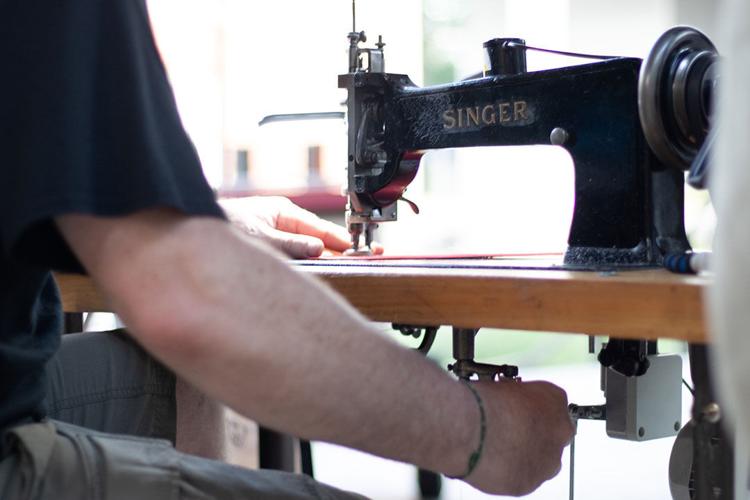
Made with tools and techniques as varied as a 100-year-old Singer embroidery machine and a picture-printing process called sublimation, Huckmade’s products synthesize historic Americana and contemporary styles to create true originals.
As his business took off, so did his client list. Starnes designed a rhinestone-encrusted Philadelphia Eagles jersey for Mary J. Blige, made ’50s-inspired garbageman jumpsuits for the Netflix series “The Boroughs,” and created the patches for Usher’s trenchcoat on his “Past Present Future” world tour, one of many projects he’s done for the pop superstar.
“[Usher’s stylist] realized he could draw something on a napkin and say, ‘This is what we need tomorrow,’ and that I can elevate it to an Usher-level stage garment,” said Starnes. “To be able to do all of that with not just other designers, but customers and multidisciplined people has been a real asset, and I learned that at Auburn.”
In May he completed a limited series of varsity jackets for storied sportswear manufacturer Mitchell & Ness, his most audacious project yet. From reimagining the brand’s historic advertisements as patches and accents, to creating the chainstitch and chenille embroidery on the hundred-year-old Singer and assembling them at his in-home studio, Starnes relied on all his past experiences. He calls the project “probably to me the most important thing I’ve ever done.”
Having finally found his creative and commercial groove, Starnes appreciates all the obstacles and detours that brought him here, and brought out the best in him.
“One path isn’t right for everybody, and a corporate job or even an apprenticeship wasn’t going to work for me. I wanted to find my own way, for better or worse, and I did that.”


