

A public service announcement for passengers flying Delta from Atlanta to Philadelphia on July 3: Bring ear plugs … just in case.
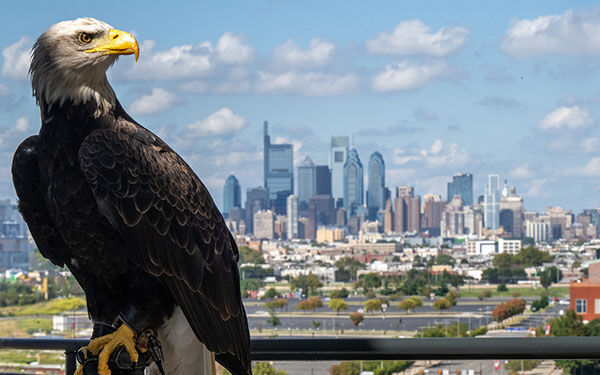
Independence, the Auburn University Raptor Center’s (AURC) often loquacious bald eagle ambassador, will be flying coach on her way to America250 festivities in “The City of Brotherly Love.” While Indy is usually quiet in flight, she can be excused a high-pitched chirp or two in the cabin since she and members of the AURC staff will be present for the America250 Time Capsule dedication and burial at Independence Hall on the morning of July 4.
“It means so much being able to bring Independence to Independence Hall,” said Auburn University Raptor Center Director Dr. Robyn Miller. “There’s a certain poetry to celebrating the 25th anniversary of the eagle flight tradition and it being so short ahead of America’s 250th birthday.”
People are also reading…
America250 attendees will have the opportunity to pose for photos with Indy and interact with AURC staff members at Independence Mall – a historic four-block plaza in Center City. With Independence Hall, the Liberty Bell and the National Constitution Center in proximity, the mall represents the starting point for exploring the nation’s birthplace.
Independence serves as an ideal guest for the occasion given the bald eagle’s symbolic significance to the United States. On June 20, 1782, the Second Continental Congress selected the bald eagle to be the centerpiece of the Great Seal of the United States. While the bald eagle was long assumed to be the official national bird, its status wasn’t codified until the U.S. Senate passed legislation in July 2024.
“What’s particularly meaningful to me is not just being able to share Auburn University and those traditions we cherish on a national stage, but also ensuring that our conservation history is at the foreground in the celebration,” Miller said.
By the mid-20th century, habitat destruction, unregulated hunting and DDT poisoning had driven bald eagles to the brink of extinction, with a low of 417 nesting pairs in the lower 48 states in 1963. In Alabama, records suggest bald eagles did not successfully nest in the state from 1949-1991. Thanks to strict legal protections and habitat conservation, the national population has rebounded to more than 71,000 breeding pairs. The Alabama Department of Conservation and Natural Resources began eagle restoration efforts in 1984 and has since documented more than 100 nests within the state.
“Bald eagles are one of the greatest conservation success stories in our history,” Miller said. “But our work as stewards of our native wildlife is far from over. As this country looks forward to the next 250 years, I think it’s important to remember how precious our flora and fauna are. Having Independence there at the burial of the time capsule seems to be a great way of ensuring that dialogue continues.”
Travels with Indy
Fittingly, for someone who works with birds of prey, Miller refers to America250 involvement as a “rabbit” she and her team spent months chasing. While the AURC conducts approximately 300 educational programs each year, out of state travel with a bald eagle involves considerable planning. Among the steps are state and federal permitting, coordination with USDA, and university Animal Care and Use (IACUC) approval to ensure that travel practices adhere to the highest standard of animal welfare. Indy’s trip is also being facilitated by the Raptor Foundation.
Since bald eagles cannot be checked as luggage or stored in an overhead bin, airline travel also necessitates advance communication with the TSA and the carrier of choice. Tray tables will remain in the upright and locked position on the row where Independence is seated. Housed within a large travel crate, Indy will be buckled into two seats with Miller and other members of the AURC team – Clinical Veterinary Fellow Dr. Amberly Sokoloff, Assistant Director of Raptor Training and Education Amanda Sweeney and Raptor Specialist Katie Pnewski – forming a buffer zone in neighboring seats.
“The airlines call passengers ‘souls,’” Miller said. “Indy constitutes two souls because she takes up two seats. She is larger than life – one soul on each wing.”
Indy will room with an AURC staff member during her overnight hotel stay, but will be tethered to a “bow perch” with a water bowl and refreshments nearby.
“We’re always deliberate about letting the hotel know who we have staying with us,” Miller said. “That way, if they have any noise complaints, they’ll be able to address them accordingly and say, ‘Sorry, that is not a very loud child.’ Thankfully, she tends to pipe down in the evenings.”