


It took nearly 15 years, researchers around the world and enough computing power to search through a universe of possibilities to answer one question:
Who goes first?
Eric Harshbarger was at a gaming convention with a friend, who was a board game designer, when a dinner conversation turned to one of the simplest parts of playing a game: deciding who gets the first turn.
Usually, everyone rolls a die. Highest number goes first. If two people roll the same number, they roll again.
His friend wondered whether he could eliminate that last step.
“He said, ‘Hey Eric, you study math. Can you come up with a set of dice?’” said Harshbarger, a senior lecturer in Auburn University’s College of Sciences and Mathematics (COSAM). “Everyone can just arbitrarily grab one of the dice and roll to see who goes first. Highest will go first, but they will never tie.”
People are also reading…
Cool, Harshbarger thought. But eliminating ties was only half the challenge. Because no matter how many of the dice were being used, each player still needed an exactly equal chance of winning.
“If all eight of them are rolling, they have exactly one-eighth chance of getting the highest number,” Harshbarger said. “But if only five people grab a die [from the eight-person set], they each have a one-in-five chance of rolling the highest number.”
In other words, his friend had managed to turn one of the easiest decisions in a board game into a trivial, yet phenomenally complicated math problem.
“You draw matchsticks or you just point at someone,” Harshbarger said. “There are plenty of ways to decide who goes first.”
Still, once the question was out there, Harshbarger wanted an answer.
“As with many, many math problems, who cares about the practicality?” he said. “Mathematically, this is a pretty interesting question.”
One roll, no ties
Harshbarger’s dice diversion began early. Growing up with role-playing games like Dungeons & Dragons introduced him to dice beyond the familiar six-sided cube.
“And I’ve always had a fascination, especially in mathematics, particularly geometry,” he said.
The new problem brought those interests together.
Harshbarger enlisted longtime friend Robert Ford, an Auburn mathematics alumnus who now teaches at Dalton State College.
Ford quickly found a solution for three players using ordinary dice. The numbers 1 through 18 could be divided among the three dice in a way that eliminated ties while preserving an equal chance of winning.
Then they worked their way up to four dice.
Harshbarger wrote a computer program to exhaustively test whether four six-sided dice could work.
Within about a week, he had an answer — no.
Which, Harshbarger admitted, was less than ideal.
Fortunately, he and Ford knew dice did not have to be cubes.
They eventually found a solution using four 12-sided dice and the numbers 1 through 48. The dice could never tie, and each player had an equal chance of rolling the highest number.
And people noticed.
The discovery received international attention, including a 2012 story in The Guardian. Harshbarger began using his laser cutter to make sets himself. Interest grew worldwide — quickly.
“Suddenly I had all these emails coming,” he said. “I was shipping hundreds of sets of these dice across the world.”
Eventually, a manufacturer began producing them.
They solved it for four players. Naturally, they moved on to five.
Searching the universe
What had taken weeks would now take years.
Computers could quickly check whether a particular arrangement of numbers worked. Finding the right arrangement amid an enormous number of possibilities was something else entirely.
“The sizes of these number spaces are phenomenally big,” Harshbarger said. “You’re getting to numbers like more than the number of atoms in the universe.”
One summer, a researcher in Indiana put a supercomputer to work searching through possibilities. Three months later, he emailed Harshbarger with an update.
“If space were the size of the number of atoms in the universe, over the summer I eliminated 1.7 of those atoms,” Harshbarger said.
Harshbarger decided to look on the bright side.
“We can make ourselves feel good and round that up to two,” he said, laughing.
There was still, essentially, an entire universe left to search.
The scale of the problem meant there was no single way to attack it. Mathematics could narrow the possibilities by identifying patterns and symmetries, while computer programs could search and test potential solutions.
“It’s this nice give and take between mathematics and computer programming,” Harshbarger said.
Over roughly 15 years, Harshbarger estimated 12 to 20 people contributed to the research, with a core group of about six. Some were mathematicians, others programmers, from across the United States and as far away as Australia and Canada.
Often, they found the project through Harshbarger’s website.
“I would love to be able to say, ‘Oh, I did all the contributions and made all the advancements,’ but that’s not the case at all,” he said. “Many of us came together with different skill sets and found solutions of different types.”
Harshbarger became the project’s steward, maintaining webpages, keeping track of discoveries and helping the work continue as researchers came and went.
Meanwhile, the board game designer who had innocently started the whole thing watched his dinner question turn into an international research project.
“He rolled his eyes and said, ‘You’ve taken this way too far,’” Harshbarger said.
His response was simple: “You opened the problem.”
Die hard
There were breakthroughs along the way, including the discovery that the dice did not even need to have the same number of sides. Researchers found several five-player solutions, but many required dice so complex they were not practical to make.
Then came a solution using five identical 120-sided dice. It worked, and a few sets were even made from aluminum.
But the group kept looking.
Around 2023, Canadian researcher Paul Meyer contacted Harshbarger with something better: five 60-sided dice.
After roughly 12 years of searching, they finally had a solution that was fair, used identical dice and was possible to make.
“We kind of feel like, ‘OK, mission accomplished. This is great,’” Harshbarger said.
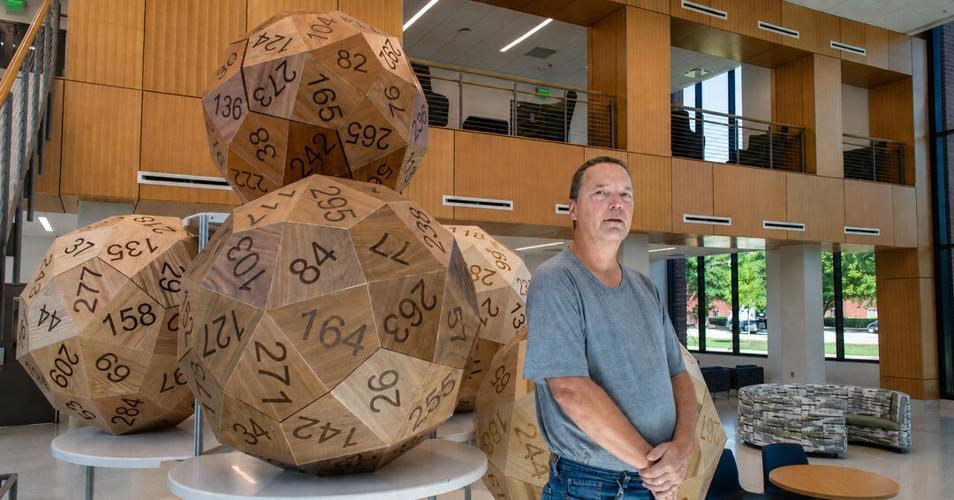
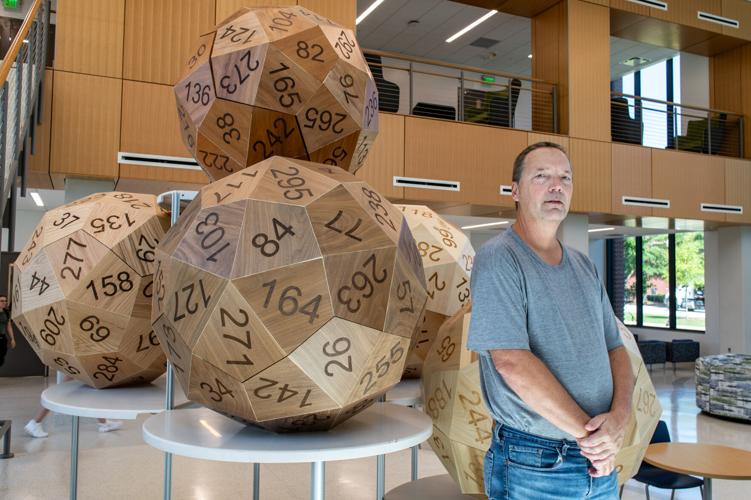
So, naturally, he decided to turn them into a gigantic sculpture to display in the College of Sciences and Mathematics (COSAM).
The timing could not have been better.
As the research reached its breakthrough, Auburn was building the STEM + Agricultural Sciences Complex, which would become the new home for COSAM. Plans for the building included finding new ways to represent mathematics in the space visually.
For Harshbarger, the five-die sculpture was a perfect fit.
Growing up he spent time in his father’s woodshop and later began creating mathematical artwork of his own.
The first die was made from pine as a proof of concept. From there came different woods, including walnut and mahogany. Each one took about a month to complete.
Their permanent location inside STEM+Ag is still being decided, but wherever they land, Harshbarger hopes they make people stop, look and ask questions.
“Maybe they don’t even realize they’re interested in these things,” he said. “If they stop and they look, then they can ask questions.”
Because somewhere in those 300 wooden faces is a story that started with a question no one needed answered, survived a search space the size of the universe and brought together people from around the world.
It took nearly 15 years to solve. And Harshbarger built it big enough to stop you in your tracks.