


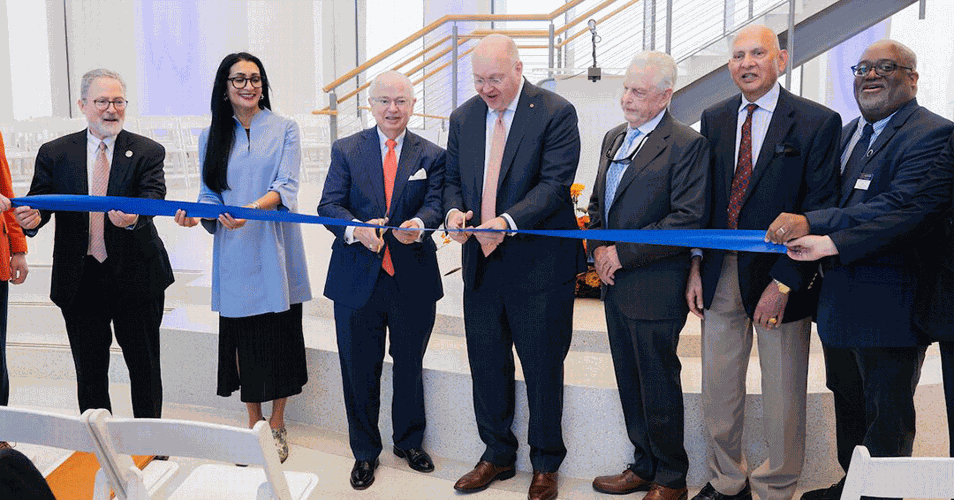
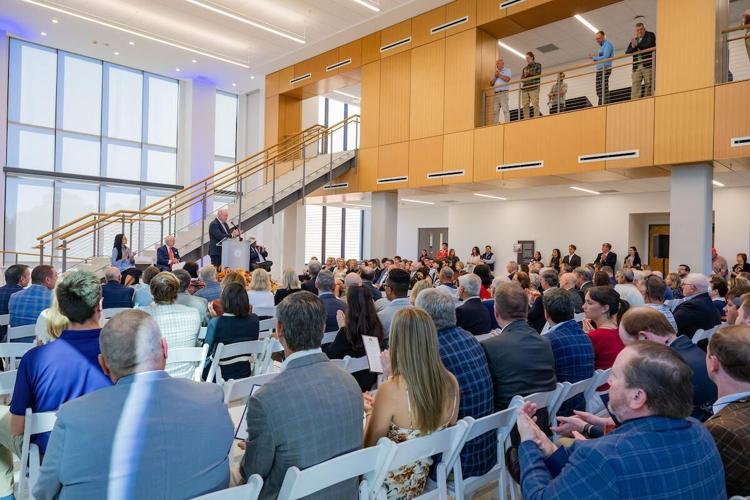
Auburn University marked the debut of its $224 million STEM + Agricultural Sciences Complex on Oct. 23, officially opening the doors to the largest academic construction project in university history and a transformational new hub for teaching, research and innovation.
Supported in part by a $50 million allocation from the state of Alabama championed by Gov. Kay Ivey through the Public School and College Authority, the project represents a significant investment in Auburn’s future as a leader in discovery and student success.
The 265,000-square-foot complex brings together six departments from the College of Agriculture and the College of Sciences and Mathematics, creating opportunities for collaboration aimed at advancing scientific discovery and addressing challenges in agriculture, health and beyond.
People are also reading…
Held at the complex’s Building A, the event brought together Auburn University President Christopher B. Roberts, Board of Trustees President Pro Tempore Jimmy Sanford, College of Agriculture Dean Arthur Appel and College of Sciences and Mathematics Dean Edward Thomas Jr.
“At its core, this building was designed around a simple idea: bringing people together so they can solve problems together,” Roberts told those in attendance. “The challenges facing our world do not fit neatly within a single discipline. Whether we are addressing food security, environmental stewardship, human health or emerging technologies, progress depends on collaboration. The STEM+AG Complex was designed with that in mind.”
Already in use this fall, the complex devotes nearly 70% of its space to teaching and research laboratories. Shared workspaces bring researchers from different disciplines into closer contact, making a conversation down the hall a potential starting point for a new partnership.
“What began as an ambitious plan to strengthen instruction, research and collaboration has become a vibrant new academic home for students, faculty and staff,” Sanford said.
For the College of Agriculture, the complex houses the departments of Crop, Soil and Environmental Sciences; Entomology and Plant Pathology; and Horticulture.
“The faculty and staff using STEM+Ag have long been known for their groundbreaking research. I cannot imagine what they will produce in such an advanced research facility as this,” Appel said. “The work these research teams do touches communities at the most fundamental level through basic human needs such as food and clean water. I am proud that these teams are now working in this modern, advanced scientific facility, and I am proud for our students, who are gaining hands-on experience in some of the very best agricultural teaching labs and classrooms available."
The College of Sciences and Mathematics departments housed in the complex are Biological Sciences, Geosciences, and Mathematics and Statistics.
"In COSAM, we pursue research that advances our understanding of the world and improves lives. We also give students meaningful opportunities to participate in that work. This complex helps us do both,” Thomas said. “As our faculty pursue new discoveries, our students will learn alongside them, developing the skills and confidence to ask their own questions and carry that work forward.”
The complex is designed to maximize natural light, and its three buildings are connected by a sky bridge as well as underground walkways. Inside, windows offer glimpses into laboratories, display cases showcase fossils and mathematical models, and some light fixtures resemble strands of DNA.
Flexible laboratory layouts also allow spaces to adapt as research needs change.
Roughly 350 faculty, staff and researchers moved into the complex over the summer. With students now filling its laboratories and gathering spaces, the focus has shifted from completing the facility to taking full advantage of what it has to offer.
“The true significance of this complex is not what Auburn built. It is what Auburn will accomplish because it was built,” Roberts said.
“Years from now, the most important measure of this complex will be the discoveries made here and the lives improved because of the work that happens within these walls.”


