

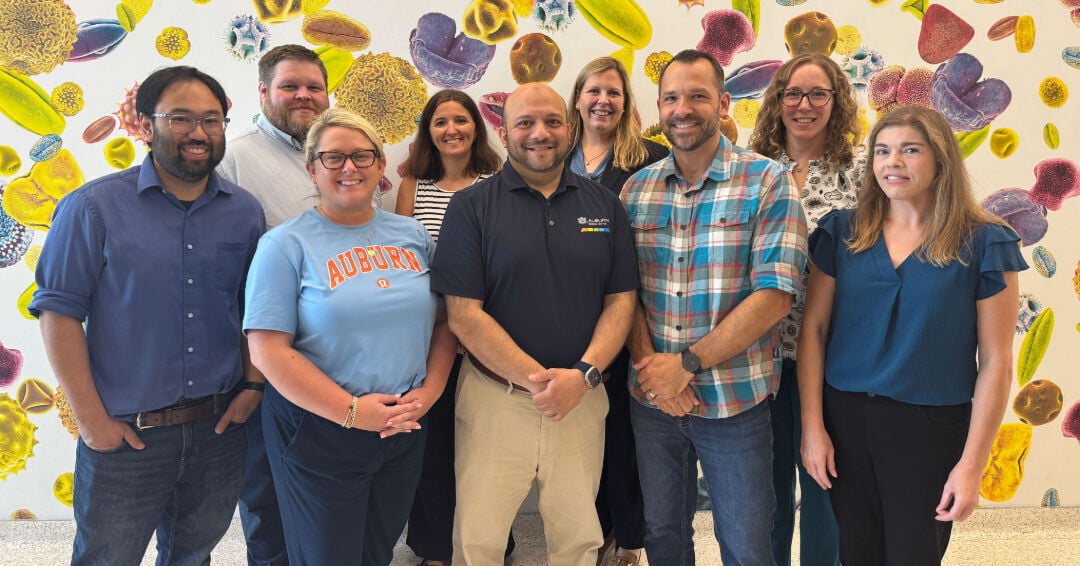
From educational escape rooms and 3D-printed learning tools to artificial intelligence, faculty coaching and place-based learning, this year’s Biggio Center Faculty Fellows bring a wide range of approaches to teaching and learning at Auburn.
The Biggio Center for the Enhancement of Teaching and Learning (Biggio Center) has announced its 2026-27 Faculty Fellows cohort, welcoming Ryan Gibson and David Crisostomo and returning fellows Virginia Kunzer, Iulia Pittman and Michael Brunson.
Faculty Fellows partner with the Biggio Center to share their disciplinary knowledge and teaching experience with the broader Auburn community. Throughout the academic year, they lead strategic projects, facilitate events and workshops, offer consultations, and support professional development for faculty, staff and graduate instructors.
People are also reading…
“We are excited to welcome Ryan and Dave to a cohort of exceptional teachers who use the Faculty Fellows platform to help others design meaningful learning experiences,” said Lindsay Doukopoulos, associate director of educational development at Biggio Center. “Dave brings creative approaches, including educational escape rooms, flipped STEM lectures and 3D-printed manipulatives, while Ryan brings leadership in science communication, improvisation and thoughtful AI-integrated assignments. Together, they demonstrate how imagination, disciplinary expertise and a commitment to students can transform teaching.”
New perspectives
Gibson and Crisostomo join the program with experience spanning veterinary education, adult education, science communication, active learning and emerging technology. Ryan Gibson, assistant clinical professor and veterinary neurologist in the College of Veterinary Medicine, combines his training in neurology and neurosurgery with a background in adult education. In addition to designing learning opportunities for veterinary students, he develops professional development programs in veterinary education for faculty at Auburn and colleagues nationwide. His areas of interest include neuroscience, clinical neurology, case-study strategies, spectrum of care and emerging technology.
Gibson’s AI-integrated assignment is featured in the Biggio Center’s AI in Teaching and Learning Showcase, which highlights how Auburn faculty use artificial intelligence in teaching, research and creative work.
David Crisostomo, senior lecturer in the Department of Chemistry and Biochemistry, has taught freshman chemistry courses at Auburn since 2017. His work focuses on active learning in large lectures and creative ways to engage students in challenging STEM courses. His approaches have included educational escape rooms, flipped lectures and 3D-printed manipulatives designed to make complex concepts more accessible to students.
Continuing experience and leadership
Returning fellows Kunzer, Pittman and Brunson bring perspectives from the arts, languages and outdoor education. Their work encompasses artificial intelligence, creative practice, faculty coaching and place-based learning.
Virginia Kunzer, professor of flute in the Department of Music, supports faculty development and initiatives related to teaching with AI. An internationally recognized performer and Miyazawa Performing Artist, she draws on her background as a musician and educator to explore how emerging technologies shape teaching, learning, creativity and human judgment, with a particular interest in the intersection of AI and the arts.
Kunzer’s work is also featured in the Biggio Center’s AI in Teaching and Learning Showcase through “From Sound to Cinema: Musically Creating Film Scenes”, which explores the integration of AI, music and creative learning.
Iulia Pittman, a professor of German and linguistics, brings more than two decades of experience in higher education and a commitment to faculty development. A certified professional coach, Pittman helps faculty navigate change, clarify goals, build on their strengths and pursue professional growth. Through individual and group coaching, she creates opportunities for reflection and connections across disciplines and career stages.
Michael Brunson, professor of practice in the Parks and Recreation Management program, draws on more than 15 years of experience in environmental education, outdoor leadership and conservation. His work focuses on place-based learning, helping students find meaning in their experiences and relationships with the natural world, connect with their communities, and develop problem-solving and critical-thinking skills.
Throughout the 2026-27 academic year, the five Faculty Fellows will contribute to Biggio Center programs, events, consultations and collaborative initiatives across Auburn. Together, their varied backgrounds and approaches will give Auburn faculty opportunities to learn from colleagues outside their own disciplines while exploring new ways to support student learning.