








Using laser spectroscopy, the Grieco Lab looks inside everyday materials to reveal properties that could shape future technologies.
A pulse of laser light can reveal a lot about a material.
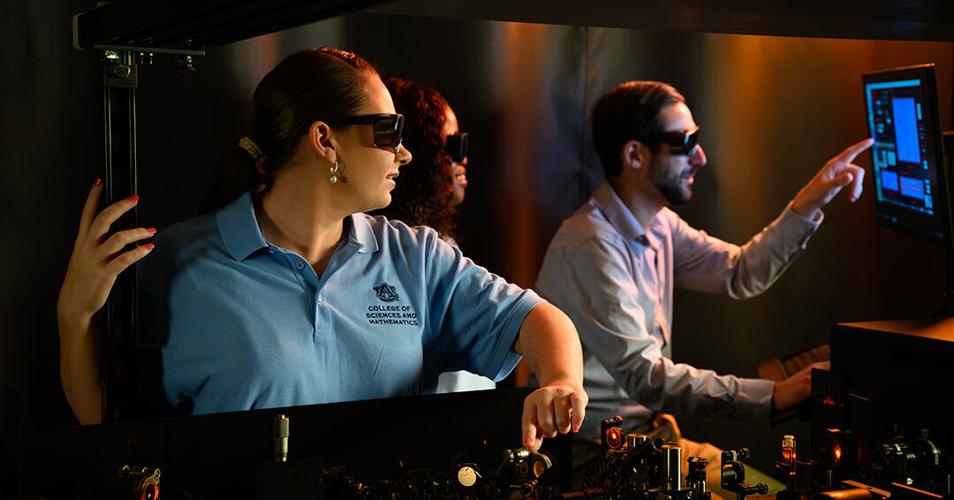
In Auburn's College of Sciences and Mathematics' Department of Chemistry and Biochemistry, Assistant Professor Chris Grieco and his students use light to take a closer look at materials most people would never think twice about, from thin polymer films to petroleum-rich rocks collected in northwest Alabama.
The lab is interested in what becomes possible when familiar materials are understood in new ways.
“Sometimes when you think of chemistry, you’re not thinking of these sorts of things,” Grieco said. “We want people to know and get excited about it.”
People are also reading…
Grieco’s group studies the properties that could make new technologies possible. Researchers prepare material samples, then use spectroscopy — a set of techniques that uses light to study how materials behave — to understand how molecular structure affects the movement of energy, electrical charge and ions.
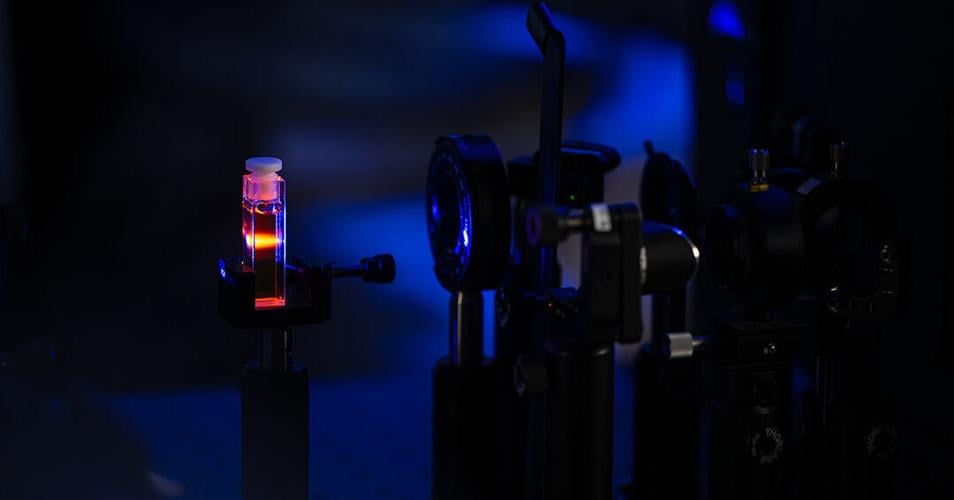
One of the lab’s primary tools is ultrafast transient absorption spectroscopy, which uses extremely short pulses of light to track what happens inside a material.
“It’s kind of like high-speed photography,” Grieco said. “You’re trying to capture really fast physical or chemical processes to learn how they work.”
The lab applies that approach to conducting polymers, materials that behave a bit like plastics but can carry electrical charge.
Their flexibility makes them promising for technologies like wearable or implantable biomedical devices. Grieco’s group is focused on the step that comes before those applications by studying how charge moves through the polymers and how their molecular structure affects performance.
“If we can learn more about how these things fundamentally operate, then we can guide the design of new materials,” Grieco said.
That same curiosity takes the lab in a very different direction with asphaltenes, complex carbon-rich molecules found in petroleum and petroleum-related materials.
Commonly associated with pavement and other petroleum products, asphaltenes are not typically thought of as high-tech materials. But Grieco believes there may be more to them.
“If we can really understand these molecules, we might be able to tap into unexplored applications for these,” he said. “We think that they may have undiscovered properties that could be beneficial for technology.”
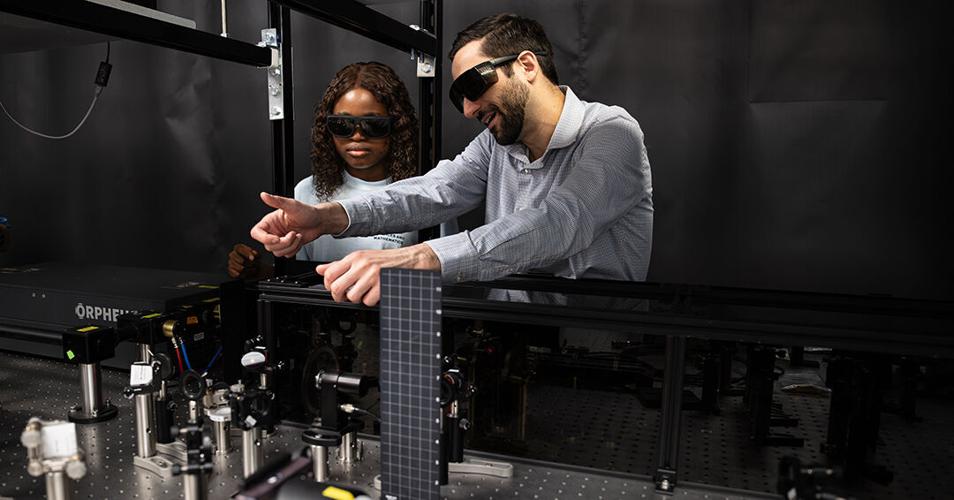
In the Grieco Lab, graduate students take the lead — designing experiments and driving the science forward. Their work is gaining national attention, featured in Auburn University’s 2026 NCAA commercial spot.
Grieco describes them as ancient materials that could have modern applications. The group is exploring their potential in electronics, semiconductors and energy storage.
The work also gives graduate students considerable ownership of the science. They develop experiments, troubleshoot unexpected results and take responsibility for answering the scientific questions in front of them.
Grieco sees that training as a central part of the lab’s work. His role, he said, is to direct and advise the research while giving graduate students the independence to move it forward. The lab’s questions may begin with materials that look ordinary, but answering them requires students to look closely, test assumptions and learn how discovery actually happens.
Whether the starting point is a flexible polymer or a material with origins millions of years in the past, the underlying approach remains the same.
Shine light on a material, look closely at what happens and see what new possibilities come into view.