


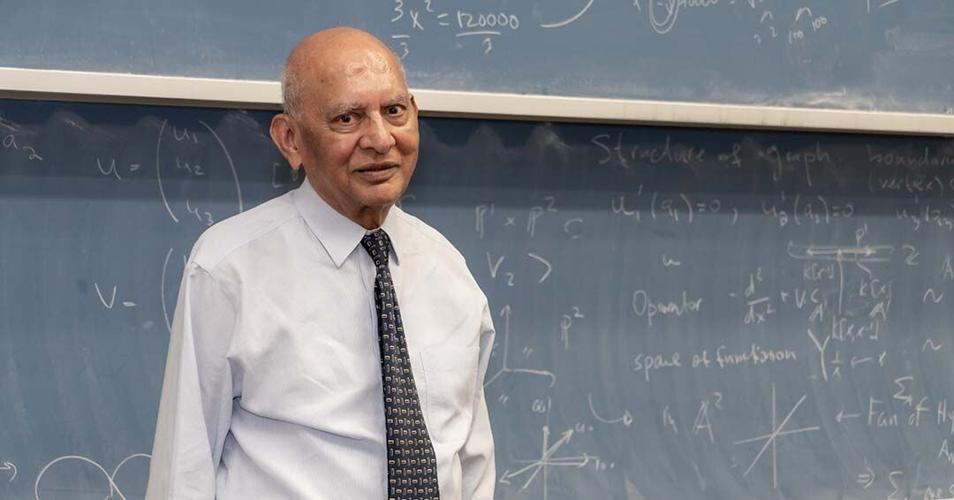
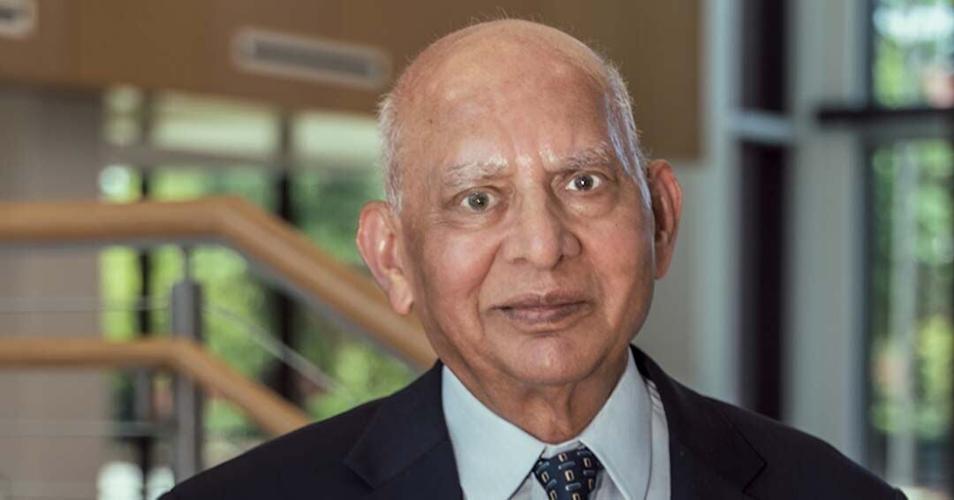
A stack of letters from former students sits among the books in Govil's office. Each offers appreciation for a professor who left a lasting impression. On his desk, a card carries a simple message: “Sometimes something wonderful happens to someone who really deserves it.”
For Govil, that wonderful thing is having a building named in his honor. But he is quick to turn the recognition away from himself and toward the people who made his career meaningful.
Govil's love of teaching began long before he entered a university classroom.
Growing up in India, he enjoyed helping his siblings and neighborhood children with their studies. Naturally curious, he often turned to his grandmother with questions about the world around him, wondering why it rained or what caused thunder.
That curiosity led him to mathematics.
People are also reading…
After earning his master's degree at just 19 years old and completing a doctorate in 1968, Govil taught in Canada and India, being promoted to professor during his tenure. He joined Auburn as a visiting professor in 1983.
What began as a temporary position soon became a permanent home.
Govil recalls being welcomed warmly by colleagues who embraced both him and his family. The support he found at Auburn helped shape what would become the defining chapter of a career spanning more than five decades in higher education.
A teacher at heart
Despite an accomplished research career, teaching was always at the center of Govil's professional life.
“I always loved teaching. It was my passion,” he said.
He taught a variety of undergraduate and graduate courses, particularly enjoying complex analysis. While he valued helping students understand challenging mathematical concepts, he also welcomed conversations that extended beyond academics.
Students frequently sought his guidance on personal and professional challenges, and Govil viewed those interactions as an important part of his role as an educator.
When asked why students connected with him, his answer was characteristically humble. “I do without expectation. God has given me this job. I should teach and research honestly,” he said.
For Govil, teaching carried a responsibility to improve lives. He often compared educators to physicians, noting that while doctors save lives, teachers can change the course of a person's future.
The letters on his desk reflect that lasting influence.
Former student Alemayehu Geremew, who studied complex analysis with Govil during his doctoral studies at Auburn, remembers a professor whose commitment extended well beyond the classroom.
“He was not only an outstanding professor but also a fatherly mentor who genuinely cared about his students’ academic progress and personal development,” Geremew said.
Others share similar memories. Maggie Han, associate dean of academic affairs and fellow mathematician, described Govil as “truly one of the nicest, most generous and supportive colleagues I've ever had.” Former master's student Stephanie Syer Gwaltney recalled his patience, kindness and unwavering support throughout her time at Auburn.
"Research in mathematics, besides being of importance for the development of science and technology, is equally important for becoming a better teacher."
Narendra K. Govil
A career defined by service
Alongside his dedication to students, Govil maintained a distinguished research career.
He published approximately 125 research papers and co-authored/co-edited seven books, contributing to mathematical analysis through his work on entire functions, polynomial inequalities and the location of polynomial zeros. His continued commitment to research is evident in a recently co-authored book, “Extremal Problems and Inequalities of Markov-Bernstein Type for Algebraic Polynomials,” and a newly published research paper.
Govil also served as undergraduate program officer and associate chair, supporting student activities and departmental initiatives.
For Govil, research was important not only to advancing mathematics but also to becoming a better educator.
“Research in mathematics, besides being of importance for the development of science and technology, is equally important for becoming a better teacher,” he said.
His work earned numerous honors, including Fellow of the National Academy of Sciences India, an Alumni Professorship, an Outstanding Advisor Award and an Outstanding Graduate Teaching Award. Still, he is more inclined to express gratitude to those who supported him than to focus on his own accomplishments.
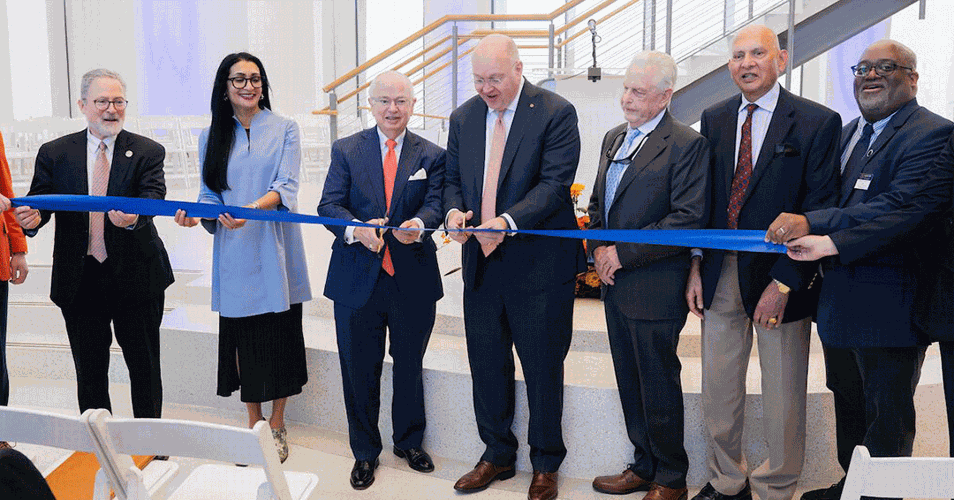
That humility was evident when discussing the naming of Govil Hall.
The honor came as a surprise gift from his son, Sanjay Govil, an Auburn alumnus who chose to recognize his father's lifelong commitment to education and the university. Govil said he never sought special recognition and certainly never imagined a building carrying his name.
“Sanjay and his wife, Vidya Govil, decided to honor me, for which I am very happy and indebted to them,” Govil said.
He credits his wife, sons and grandchildren for the joy and stability that have sustained him throughout his career and believes family remains the truest reflection of a person's character.
“You can hide your actions and true self from anyone, but not from your family,” he said.
An enduring legacy
As Auburn celebrates Govil Hall and the professor whose name it bears, Govil remains focused on those who made the journey worthwhile: his students, colleagues and loved ones.
“I have enjoyed my life and consider myself very fortunate to be blessed with a good and successful profession and a wonderful family,” he said.
The sentiment captures the humility that generations of Auburn students and colleagues have come to know.
For a professor whose career has touched so many lives, the letters on his desk offer a powerful reminder that his greatest legacy is not a building, but the people whose lives he helped shape.


