


Rental tax ordinance proposal — fact sheet
October 15, 2026
We know that the City of Opelika is growing. As a result, many times municipal policies must evolve. The rental market today in Opelika includes many different forms of rental activity like residential rental, commercial rental, short-term rentals, and storage facilities. The Administration recognizes the growth as well as the business activity.
Purpose and scope
- The city’s stated goal is a clearer process for licensing and tracking rental properties and supporting safe, responsible rental operations.
- The proposal covers residential rentals, commercial rentals, short-term rentals, and self-storage facility rentals. The requirements and charges differ by rental category.
- The city does not yet have a confirmed total of affected properties or a reliable estimate of additional revenue.
People are also reading…
Proposed taxes and license fees
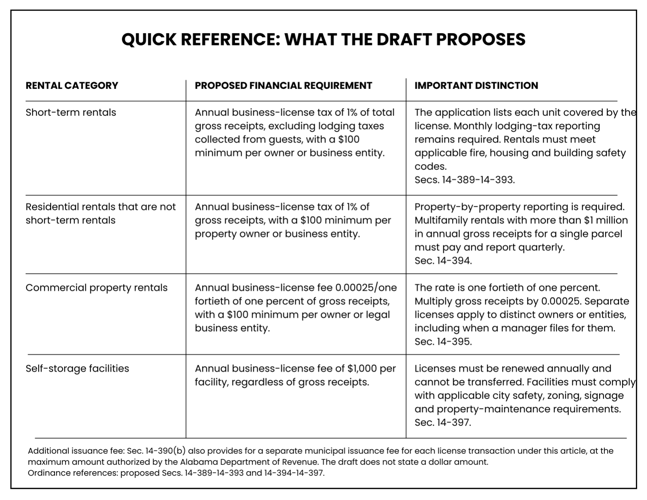
- Short-term rentals: An annual business-license tax of 1% of total gross receipts, excluding lodging taxes collected from guests, with a $100 minimum per owner or business entity. Applicable lodging tax is additional. The application must list each housing unit covered by the license.
- Residential rentals that are not short-term rentals: An annual business-license tax of 1% of total gross rental receipts, with a $100 minimum per property owner or business entity. This category includes rental houses, apartments, condominiums and other residential rental properties.
- Commercial rentals: An annual business-license tax of 0.00025, or one fortieth of one percent, of gross receipts, with a $100 minimum per owner or legal business entity. This category includes properties rented for stores, restaurants, offices, warehouses and similar business uses.
- Self-storage facilities: An annual business-license fee of $1,000 per facility, regardless of gross receipts. Licenses must be renewed annually and cannot be transferred.
- A separate municipal issuance fee would also apply to each license transaction under this article. The draft sets the fee at the maximum authorized by the Alabama Department of Revenue but does not state a dollar amount.
- Gross receipts are not profit. Percentage-based license taxes are calculated on rental receipts, not the amount remaining after expenses. The draft includes rental payments, cleaning fees, mandatory service fees and other nonrefundable charges in gross receipts. Refundable deposits are excluded.
- The $100 minimum is not an additional $100 added to the percentage calculation. It does not include the separate municipal issuance fee or separate applicable lodging tax collected by operators.
Where the residential tax revenue would go
- The residential charge is a business-license tax, not a regulatory or inspection fee.
- Residential business-license tax revenue would go into the city's general fund and would not be restricted to rental inspections or code enforcement.
Property owners and reporting
- The residential section does not provide a general exemption for someone who rents only one home. It applies to owners who rent residential property to others.
- For residential rentals that are not short-term rentals, the $100 minimum applies per property owner or business entity, rather than per rental unit. Separate legal entities are treated separately.
- Residential and commercial rental applications and renewals must include the owner's name, property addresses and gross rental receipts for each property for the preceding calendar year.
- Multifamily residential rentals with more than $1 million in annual gross receipts for a single parcel must pay and report quarterly under Sec. 14-394(i).
- A property manager may submit required information and payments for an owner. Using a manager does not remove the owner's reporting and payment responsibilities or replace the manager's separate licensing obligations.
Short-term rental requirements
- The draft generally defines a short-term rental as a dwelling, or part of a dwelling, rented for fewer than 30 consecutive days, with limited exceptions stated in the definition.
- Short-term rentals must meet applicable fire, housing and building safety codes and applicable city rules, including zoning, noise, parking and trash requirements.
- Each short-term rental must have a designated adult contact who lives in Lee County, is available around the clock during rental periods and responds at the property within one hour when requested by a city employee. The contact information must be posted inside the unit.
- The business-license number must appear on each advertisement or listing on a hosting platform.
- Lodging-tax payments and monthly reports are due by the 20th of the following month. Using a booking platform to collect lodging taxes does not remove the licensed owner or operator's reporting and payment responsibilities.
Legal background and licensing consequences
- Sec. 14-318(h) can require council approval of future business-license applications after a license or licensing privilege is suspended or revoked. That can affect unrelated businesses and businesses in which the affected person has an ownership interest.
Timing and council action
- The draft's proposed effective date is February 1, 2027, if adopted as written.
- Short-term, residential, and commercial rentals lawfully operating on the effective date would have 30 days from that date to obtain the required short-term rental license. This provision applies specifically to short-term rentals, not every rental category.
Examples of proposed costs
Residential rental property — 1% of gross receipts
If a property owner receives $24,000 per year in gross rent:
$24,000 × 1% = $240 annual business-license tax.
If the owner receives only $8,000 in gross rent, 1% would equal $80, so the $100 minimum would apply instead. The minimum is per property owner or business entity.
Short-term rental — 1% of gross receipts
If a short-term rental produces $36,000 per year in gross receipts:
$36,000 × 1% = $360 annual business-license tax.
Commercial rental property — 0.025% of gross receipts
If a commercial property owner receives $1,000,000 per year in gross rent:
$1,000,000 × 0.00025 = $250 annual business-license tax.
If gross receipts were $200,000, the percentage calculation would be $50, so the $100 minimum would apply.
Self-storage facility — flat $1,000 per facility
There is no percentage calculation under this version of the ordinance.
1 facility = $1,000 annually
2 facilities = $2,000 annually
3 facilities = $3,000 annually
The fee applies per facility regardless of gross receipts.
These examples show the proposed business-license tax or fee only. A separate municipal issuance fee may also apply to a license transaction. Short-term rentals are also subject to the applicable lodging tax.


