


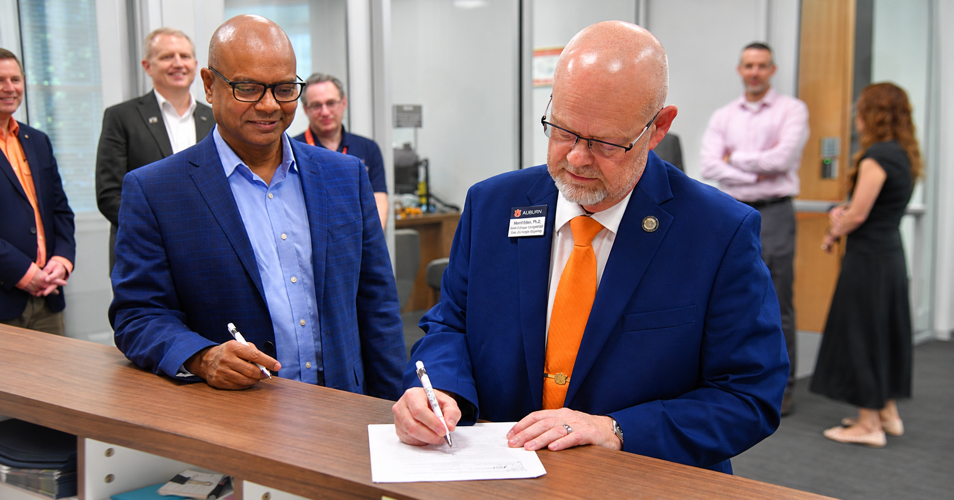
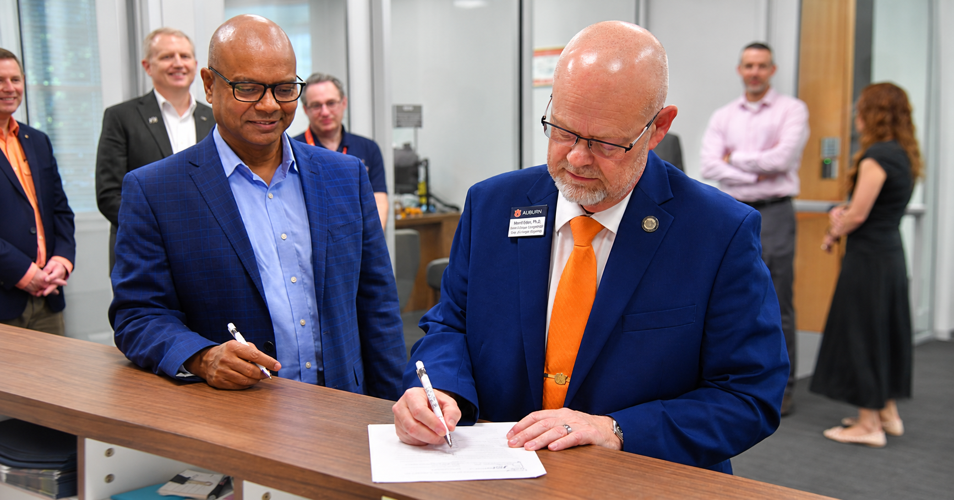
Auburn University’s McCrary Institute for Cyber and Critical Infrastructure Security is pleased to announce the formation of a new collaboration with Lawrence Livermore National Laboratory (LLNL) that will advance cybersecurity research and strengthen the protection of the nation’s critical infrastructure.
The alliance will bring together LLNL’s deep scientific and technical expertise in developing and guiding the secure, resilient and sustainable operation of information technology and operational networks, with Auburn University’s research capabilities and the McCrary Institute’s established expertise in the concerns and needs of critical infrastructure owners and operators.
As part of this collaboration, the McCrary Institute will help connect LLNL researchers and technical tools and capabilities with energy-sector leaders, creating opportunities to translate advanced research into practical applications that address real-world cybersecurity challenges.
People are also reading…
“America’s technological advantage depends not only on how quickly we innovate, but on our ability to ensure those innovations are secure, reliable, and ready for the real world, especially in critical infrastructure, where failure is not an option,” said Frank Cilluffo, director of the McCrary Institute. “That’s what makes this alliance so important. By combining Lawrence Livermore’s world-class scientific expertise with McCrary’s independent testing and validation capabilities and our relationships with energy sector operators, we can help bridge the gap between technological breakthroughs and operational security.”
The collaboration builds on McCrary’s leadership of the Southeast Region Cybersecurity Collaboration Center (SERC3), a U.S. Department of Energy-supported initiative that works with electric utilities and industry partners to strengthen the cybersecurity of operational technology and defense-critical electric infrastructure. Members of the SERC3 Industry Advisory Board will be key players in connecting the technical insights of LLNL with the needs and real-world applications of energy providers.
Central to this work will be the McCrary Institute’s new Edge Lab, which tests, refines and proves defenses for America's most critical systems under real-world conditions. Powered by senior leaders and Auburn students, the Edge Lab brings together the insight from technology partners, operators, federal agencies and national labs, tests solutions against real infrastructure and gets results into the hands of the people defending America’s critical systems.
“The challenges facing our nation demand new approaches and a greater exchange of ideas across institutions,” said Anup Singh, principal associate director for the Strategic Threat Analysis and Response Directorate at LLNL. “By building on our shared commitment to scientific excellence, we can open new avenues for discovery and strengthen our ability to respond to evolving national security needs.”
As advanced technologies, including large language models, become increasingly integrated into the systems that power the nation, rigorously testing, validating and securing those technologies before deployment is becoming a national security imperative. This collaboration will help bridge the gap between scientific innovation and practical application, combining national laboratory research with independent technology evaluation and the firsthand experience of critical infrastructure operators.
“By joining forces with the McCrary Institute to defend the nation’s power grid, water systems and other critical infrastructure, we can accelerate the transition of frontier technology into private industry and help the operators on which our nation depends,” said Nate Gleason, program leader of LLNL’s Cyber and Infrastructure Resilience Program.
This announcement marks the beginning of LLNL’s relationship with Auburn University, which will explore opportunities to expand research collaboration, facilitate faculty and student exchanges, develop internship pathways and strengthen the workforce needed to secure critical infrastructure.
“Cyber threats facing our nation are too complex for any one organization to address alone,” said Steve Taylor, senior vice president of research and economic development at Auburn University. “Auburn is committed to working with government and industry partners to strengthen cybersecurity and protect our national security. Our partnership with Lawrence Livermore National Laboratory brings together expertise and capabilities in support of our shared mission.”
“This collaboration reflects Auburn's commitment to building strategic partnerships that create new opportunities for students and strengthen our academic and research enterprise,” said Mario Eden, dean of engineering. “Working with Lawrence Livermore National Laboratory will help expand experiential learning opportunities, support future research collaboration and contribute to the development of the highly skilled workforce needed to meet emerging national challenges.”
For more on the collaboration and the evolving threats to critical infrastructure, watch or listen to LLNL’s Nate Gleason discuss emerging technology, grid security and resilience with Frank Cilluffo on the Cyber Focus podcast.