


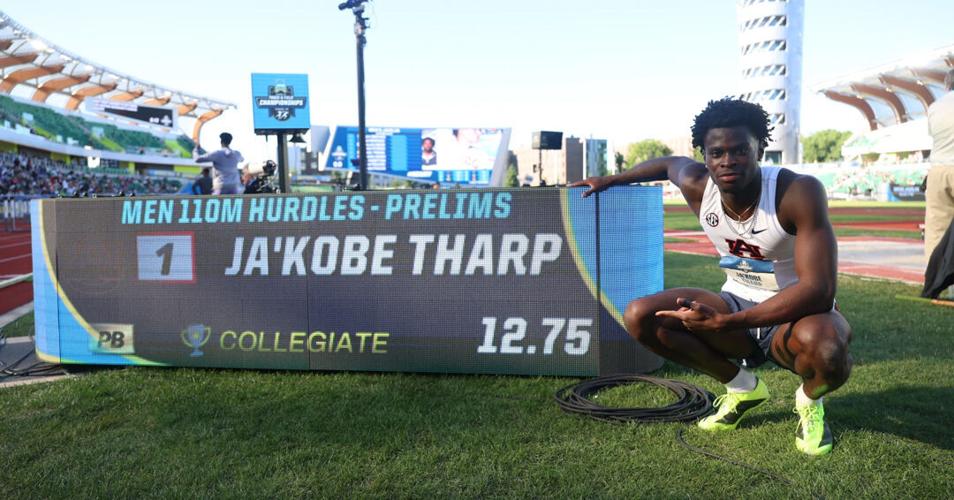
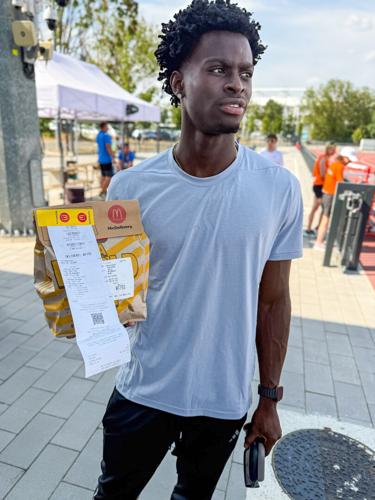
On June 10, at approximately 3 p.m., just before heading to the University of Oregon's Hayward Field, interdisciplinary studies senior Ja'Kobe Tharp ate two cheeseburgers, a large fry and 10 Chicken McNuggets.
Three hours later, he set a world record in the 110-meter hurdles.
To a nutritionist, consuming 1,246 calories of McDonald's (not including the sweet and sour sauce) before an event like, say, the 2026 NCAA Outdoor Championships might sound strange, ill-advised, even antithetical to athletic performance.
But to Tharp, it makes all the sense in the world. That's just how he rolls, he says — how he runs, at least since winning the Tennessee state hurdles championship as a high school junior after downing the same meal.
Three hours before the Auburn track and fielder hits the finish line, he hits the Golden Arches.
People are also reading…
"Every time," Tharp says. "Every time I run, no matter where it is."
"Coach Ken (Harnden) told me that I'm going to change my diet soon. But I mean, hey, if it ain't broke, don't fix it."
He's lovin' it: Ja'Kobe Tharp poses with the McDonald's meal that has become his pre-race tradition on July 14 in Budapest, Hungary. Three hours later, he came in first in the 110-meter hurdles at the István Gyulai Memorial.
Well, maybe, Mobley says. There's the timing of it, for one. A meal like that three hours before a race would definitely keep distractions from hunger at bay. Not that he'd advise it or anything, especially not for long-distance runners; Mobley says the level of fat in Tharp's pre-hurdle habit has a way of redirecting blood and energy to your gut rather than the muscles you're counting on.
"If a marathon runner were to eat this meal, they're probably going to be having some gastrointestinal distress," Mobley says. "But a race that's just 13 seconds" — or, in Tharp's case, 12.75 seconds — "is really just activating the ATP phosphocreatine system, with a little bit of anaerobic glycolysis" — i.e., drawing on the body's immediate energy stores.
What Mobley points to as a definite positive is less what Tharp eats than why he eats it. Because whatever McEdge Tharp may enjoy over the competition may stem more from superstition than nutrition.
"It's possible there's some slight carb-loading going on," he says, "but I think the psychological component may be the most important thing happening."
It's a phenomenon Mobley has seen firsthand: Whether it's the music they listen to or how they put on their socks, habits before competition are huge.
"Every athlete has their own thing like that. 'Hey, I'm eating this meal, this is what I do.' I think consistency along those lines can help you avoid decision fatigue and really reduce pre-race anxiety, which is good" — good enough in Tharp's case to counterbalance whatever negative nutritional impact his tasty training tradition might bring.
Oh, and that 2,590 mg of sodium might be good, too.
"Yeah, the sodium stuff is real. Like having that much sodium, more than 100% of the recommended daily value? Especially in the late spring or summer when it's really hot, I think that does help support what we call plasma volume and fluid balance."
And fluid balance is one best practice Tharp salutes.
What's he wash it all down with? A Sprite? A Coke? A milkshake?


