

Content body
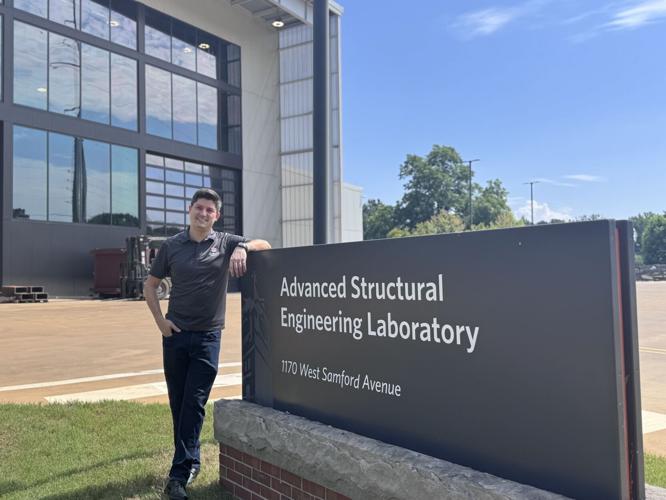
Tarozzo stands outside the Advanced Structural Engineering Laboratory at Auburn University where he conducts his research.
For Murilo Tarozzo, the word “connection” is the throughline of his life. It describes his doctoral research, his experience at Auburn University and the impact engineering can have on the world around us.
Tarozzo, a doctoral student in geotechnical engineering in Auburn’s Department of Civil and Environmental Engineering, studies the interaction between foundations and the soil, with his current work focused on bridge foundations and infrastructure. His dissertation research examines how the substructure of a bridge — the foundations buried below the surface — connects to the superstructure above it, including the columns, footings and other visible components.
People are also reading…
“My research is very connected,” Tarozzo said. “The title of my dissertation is literally 'Connections.'”
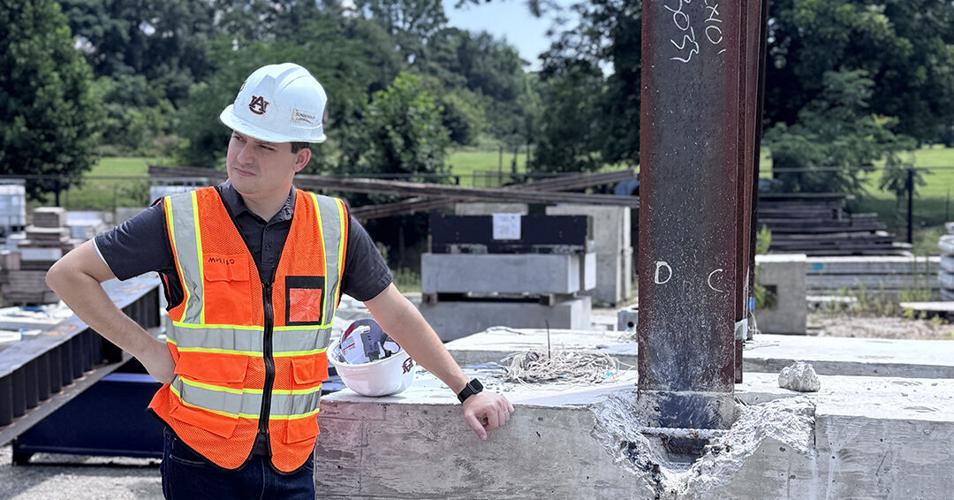
Tarozzo measures the behavior of the foundation connected to the superstructure, and how that affects the behavior of the entire structure as a whole. His research helps inform how to design a bridge to be safer so it will not collapse during a natural or man-made disaster.
“We need to understand the behavior of a bridge when it's deformed during a hurricane or during the impact from a boat, for example,” Tarozzo explains. “Imagine that happening when a driver is passing over the bridge. You can risk a lot of lives or isolate a lot of communities if a bridge collapses during one of these events.”
That focus on connection is a common thread throughout his work. Bridges are the infrastructure that connect people with different places and connect entire communities. Tarozzo’s bridge foundation research looks at the different variables that can affect the behavior of the entire bridge structure. If he can understand how a bridge might behave in such adverse conditions, engineers can design and renovate bridges that remain safer and more reliable for the people and communities they serve.
His research also connects theory to practice. Tarozzo chose Auburn for his doctoral program in part because the research in geotechnical engineering is strongly connected to industry and real-world problems. Auburn’s program places an emphasis on experimental testing, data collection and real results that can inform bridge designers, government agencies and industry software.
“The good thing about the research here at Auburn University is that it’s very applied,” he said. “The connection that we have here with industry is very strong.”
Before coming to Auburn, Tarozzo worked as a geotechnical engineer in Brazil for seven years. He earned his undergraduate and master’s degrees from the University of Campinas, known as UNICAMP, in Brazil. He credits graduate research with helping him see how academic inquiry could be used to solve real-world engineering problems that improve people’s lives.
At Auburn, Tarozzo found another kind of connection in the research group led by Brian Anderson, his major professor. Tarozzo, who is a graduate research assistant and a Presidential Graduate Research Fellow, said the group’s collaborative environment stood out because students support one another, build on each other’s work and help move research forward together.
“Life is a group project,” Tarozzo said. “You can’t do anything alone. Any project in life, any project in work, is not something you do alone all the time. You have to rely on others. And more than that, we have to learn from others.”
That underlying current of connection shapes the advice he offers other students considering graduate school: stay disciplined, learn to work independently, but help colleagues and ask for help when needed. Colleagues, he said, are a graduate student’s best resource, not competition.
“Working together as a group is what’s going to take you further, I believe,” he added.
As he prepares to graduate in August, his connection to the Auburn Family will remain one of the most meaningful experiences of his career. While he will miss his research team, Tarozzo will make new connections at Texas State University this fall as an assistant professor of civil engineering. His goal is to mentor the next generation of engineers to connect theory to practice while connecting people to one another in the pursuit of a stronger, safer world.