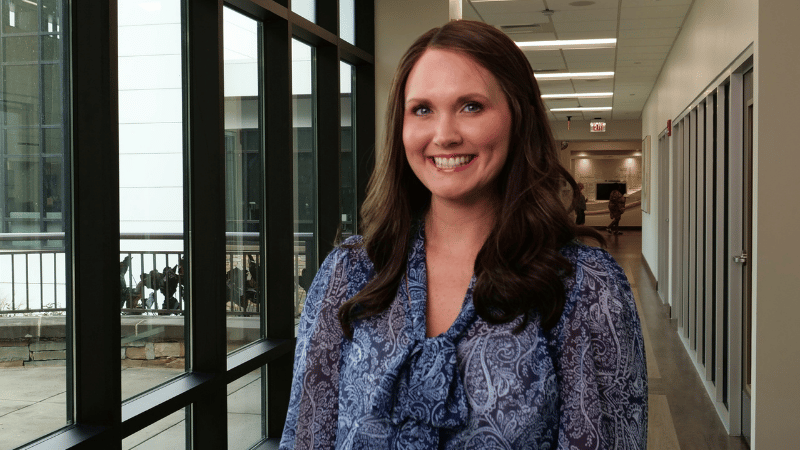


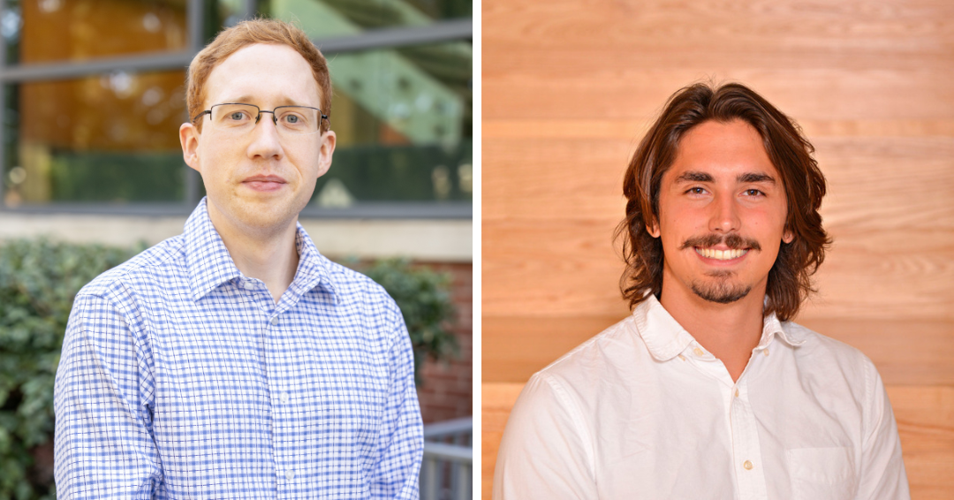
Physics graduate students Chris Coger and Winston Solsrud have received U.S. Department of Energy Office of Science Graduate Student Research (SCGSR) awards to pursue thesis-related work at Oak Ridge National Laboratory.
Arrange molecules one by one on a metal surface, and they can form an artificial lattice with unusual quantum properties. Read the light emitted at the edge of a fusion plasma, and it can reveal the plasma’s temperature and density. Auburn Department of Physics graduate students Chris Coger and Winston Solsrud are pursuing these challenges with scientists at Oak Ridge National Laboratory in Tennessee. Their work could help identify materials for quantum computing and develop faster ways to monitor plasma in future fusion reactors.
Both students received U.S. Department of Energy Office of Science Graduate Student Research (SCGSR) awards to pursue thesis-related work at Oak Ridge. Selected through external peer review, the awards connect them with specialized expertise, large-scale computing and experimental capabilities that can help advance their research.
People are also reading…
“I believe that having two Auburn physics students selected for the DOE SCGSR award simultaneously speaks very highly about the quality of the research being conducted by graduate students within the department,” said David Ennis, professor of physics. “We also had a third student win this award just last year, Jessica Eskew, so the department is on a bit of a roll.”
Coger’s research in quantum materials
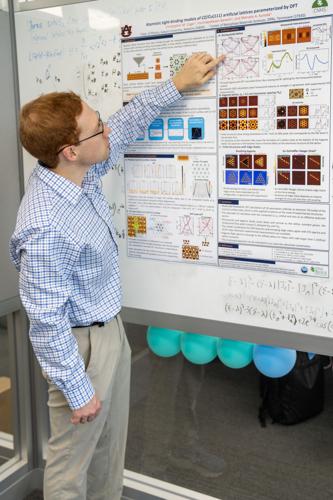
Coger studies materials that could help advance quantum computing. His project focuses on artificial lattices made by arranging molecules on metal surfaces. Because these structures are difficult to put together experimentally, he is using computer simulations and machine learning to predict which arrangements could produce unusual quantum states called topological phases.
“As these artificial lattices are difficult to make, it is imperative to produce predictive frameworks for their design that account for both the material composition and the geometric arrangement,” Coger said.
At Oak Ridge’s Center for Nanophase Materials Sciences, Coger will work with P. Ganesh, who leads the center’s theory and computation section, and with experimentalist An-Ping Li’s group. Li’s team uses scanning tunneling microscopes — tools that can image and position individual molecules on a surface — to build the lattices. Together, the groups can calculate, build and test the structures.
“Having all those capabilities in one place will serve as a unique catalyst for my research,” Coger said.
Coger’s adviser, Marcelo A. Kuroda, associate professor of physics, said the collaboration will broaden Coger’s thesis work through a multiscale approach and expose him to computational methods and resources beyond those available at Auburn.
“For Chris, it will be a unique experience to work with a different group of scientists,” Kuroda said. “He will be in close contact with experimentalists, offering the opportunity to be part of the iterative process in the project.”
Coger hopes to continue in research at a national laboratory or university after graduation. He sees the award as a chance to learn methods that could shape his work beyond his thesis.
“I’m looking forward to learning a new set of computational methods that not only benefit my thesis but are also expected to play a significant role in the future of the field,” Coger said.
Solsrud’s research in fusion energy
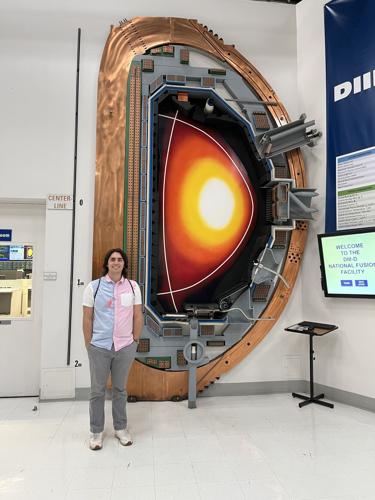
Solsrud studies light emitted by hydrogen atoms at the edge of a fusion plasma, a superheated, electrically charged gas. The light can help researchers measure the plasma’s temperature and density. His adviser, Stuart Loch, professor of physics, said the diagnostic could also help identify detachment, an important condition as scientists work to understand and control the plasma edge.
“One goal of this project is to determine whether this light can be measured and analyzed in less than a tenth of a second, laying down the groundwork for a real-time diagnostic that could help monitor and control plasma in future fusion reactors,” Solsrud said.
At Oak Ridge, Solsrud will work with Bart Lomanowski in the Power Exhaust and Particle Control Group within the Fusion Energy Division. Filippo Scotti, a scientist at the DIII-D fusion research facility in California, will provide scientific guidance and help design potential experiments. Solsrud’s work will also draw on measurements from a spectrometer Auburn researchers installed at DIII-D.
Loch said Oak Ridge’s Fusion Energy Division specializes in artificial intelligence and modeling the edges of fusion plasmas.
“Both of these specializations will be very useful in developing Winston’s research project,” Loch said.
Auburn’s connection to DIII-D has already given Solsrud experimental data to develop and test his model. Loch said Auburn’s fusion group also helped prepare him for the award.
“Auburn also has a large fusion energy group with experience in this area,” Loch said.
Solsrud hopes to continue as a physicist and sees the placement as a chance to build relationships across the field.
“I look forward to learning from experienced scientists, developing new research skills, and gaining a broader perspective on collaborative research that will help shape my future career as a physicist,” Solsrud said.
Building Auburn’s research pipeline
Ennis said the value of the placements extends beyond the students’ research projects.
“These programs are an effective tool to recruit excellent students into science and also retain them by giving them a unique experience and improved job prospects,” he said.