


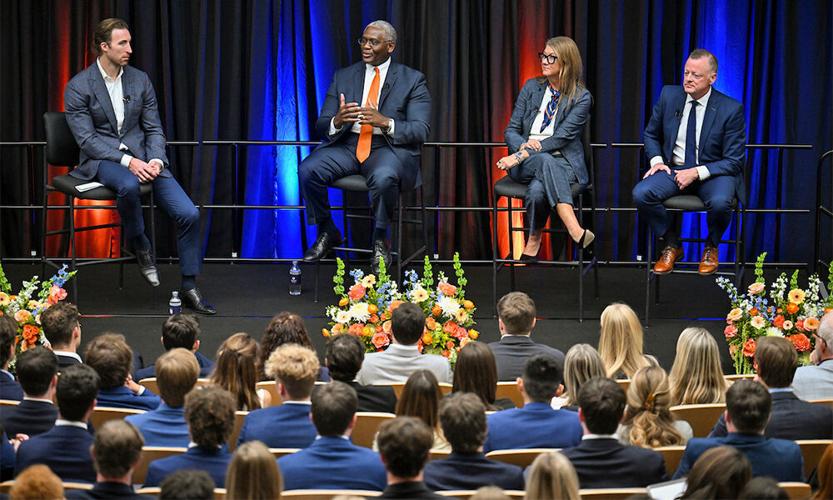
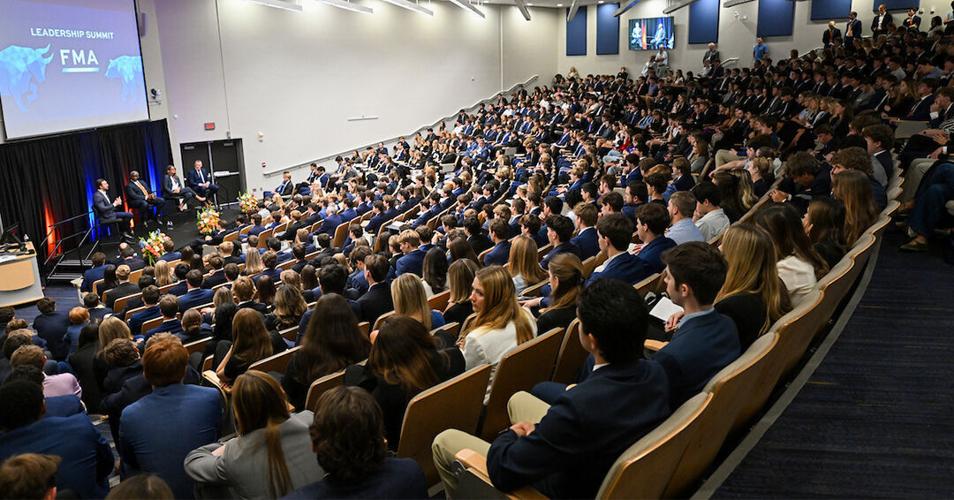
Three prominent executives recently visiting Auburn University and an audience of almost 700 Harbert College of Business students shared a common viewpoint: Artificial intelligence and cybersecurity have a steadily growing influence on today’s managerial decision makers.
Future Harbert graduates entering the workforce should prepare to face the related challenges head-on, they said, and in a variety of ways, including human interaction.
Auburn's student-led Financial Management Association (FMA) National Honor Society recently concluded its annual leadership summit, which featured the panel of speakers in an open question-and-answer session.
Sharing from their successful careers in financial leadership were:
- Tim Vines, CEO, Blue Cross and Blue Shield of Alabama and an Auburn alumnus
- Jennifer Mann, senior advisor, Coca-Cola; former executive vice president and president, North America Operating Unit
- Scott Case, executive vice president and head of Global Tech and Operations, Prudential Financial
People are also reading…
Harbert College’s Department of Finance and the Harbert Investment Center supported the event, which catered to students considering careers in finance, including banking, accounting, investment management and other business-related fields.
Addressing health care costs
Technology was only one of the key talking points with the panel, but it stood out as a centerpiece of conversation because of its far-reaching impact on a diverse range of workplace factors.
Vines, who grew up in LaFayette, played briefly with the Auburn baseball team and is a 1988 graduate, oversees a company in Blue Cross Blue Shield that requires much more of its workforce than simply selling insurance, he said.
Such as trying to find ways to cut costs, something technology can help do in any business, according to the panel.
“Rising health care costs... everybody is experiencing it,” Vines said, attributing increases to a wide variety of reasons ranging from shortages of medical personnel and facilities to the costs faced in keeping them.
“Health care is very expensive. When you look at company books, one of their largest expenditures is health care coverages,” he said. “They’re looking at: cost, cost, cost.
“Quite frankly, we inside the company don’t see anything changing anytime soon, and that is very frightening,” he said. However, using every tool available such as AI, “our administration costs are some of the lowest in the business.”
The challenge of providing Blue Cross Blue Shield customers and clients the best possible coverage plans vs. the costs involved is never-ending, Vines said, thus the need to explore all options, including technology. Likewise for the need to protect sensitive patient information.
AI also is available to help with training associates and medical staffs.
Vines, however, reminded the students of something he feels is even more important: the human touch.
He credits his mother for inspiring him to learn the joy of serving others. “I saw in her, her servant’s heart,” he said, “so a servant’s heart is critically important to me. If you’re willing to serve, then you will go a long way in life.
“It’s not all about you,” Vines told the students. “That’s at the core of the people I try to surround myself by.”
The demand for cybersecurity
Case, working in Prudential’s vast global financial operations, put emphasis on the cybersecurity side of technology and the need for future business leaders to understand and become well-equipped in handling it.
“Cybersecurity. That’s the No. 1 thing in my world that I worry about,” he said, calling it the biggest risk to his company outside of natural risks. “We’re having to deal with vulnerabilities much faster... having to patch (to stop hackers) in a matter of hours or days, not months as previously.
“You have to have strong polices, strong standards, strong controls in place,” Case said. “You have to be on top of it every day.”
The need for cybersecurity emphasis has grown into almost every industry and every-size company. “There is a whole industry and economy around it,” he said, adding that any technology plan should include “a human in the loop” approach.
Mann talked about how the Coca-Cola company also places a high value on human relationships, including matching employees to their strengths; and uses AI and other tools in doing research, such as exploring merger ideas and seeking to retain or find new contracts as with restaurant chains.
Hiring good people with a strong work ethic still matters most, she said. “What you want, is the smart person who has heart.”
She also shared an observation with the students aspiring to be in leadership roles.
“Most senior executives in the company are using AI,” Mann said, with it being important to do so to understand the tools and habits surrounding their employees.
She gave the students an interview tip, for their own awareness and not just to impress a hiring manager. “A great question to ask as you talk with companies is, ‘how does your senior leadership use AI?’”
‘Don’t panic...be patient’
Steve Aldridge, an Auburn alumnus working as the global co-head of Healthcare Investment Banking with Cantor Fitzgerald, moderated the session for the ninth consecutive year.
“I love to come back because once you graduate from Auburn, it always stays with you,” he said. “And given what this school has evolved in with me over the last 20 years, seeing that progress each and every year I come back is motivating and inspiring.”
He credited the event for its value to students.
“It allows them to be exposed to real-world leaders in the business world,” Aldridge said. “The amount of information they gather from an hour-and-a-half summit with three established individuals like we have here today is invaluable and hard to come by. You can go pay for it and read it in a book, but hearing it live and hearing them answer real questions is invaluable.”
In his own message to the students, he encouraged them to be patient and not to try and determine all the answers at the starting line. “Don’t panic. It will be OK,” Aldridge said. “You may not get your dream job right out of school. Chances are, you don’t know what your dream job is. And it’s OK. Don’t panic.
“Take your time. Be tenacious. Listen. ... Be patient, be humble, be grateful. Success will come.”
Measures of success
Tracy Richard, executive director of the Harbert Investment Center and the faculty organizer of the event, praised the panelists for their contributions to a standing-room-only crowd.
“I thought this year’s summit was fabulous!” she said. “All three panelists brought different perspectives, with Scott drawing on his technical background, Jennifer from an operational perspective, and Tim emphasizing the importance of relationships and the people we serve.
“But what resonated most with me was what they all had in common. Despite their incredible success, all three emphasized hard work, gratitude, humility and the importance of the people around them.”
She also appreciated the closing statement by Aldridge.
“’Don’t panic!’ It’s such an important message at this stage in their lives,” Richard said. “If they work hard, prepare, and are intentional about their next steps, opportunities will come.”


