

Pushing the frontier of plasma physics research is a lifelong passion for College of Sciences and Mathematics Dean Edward Thomas ’96.
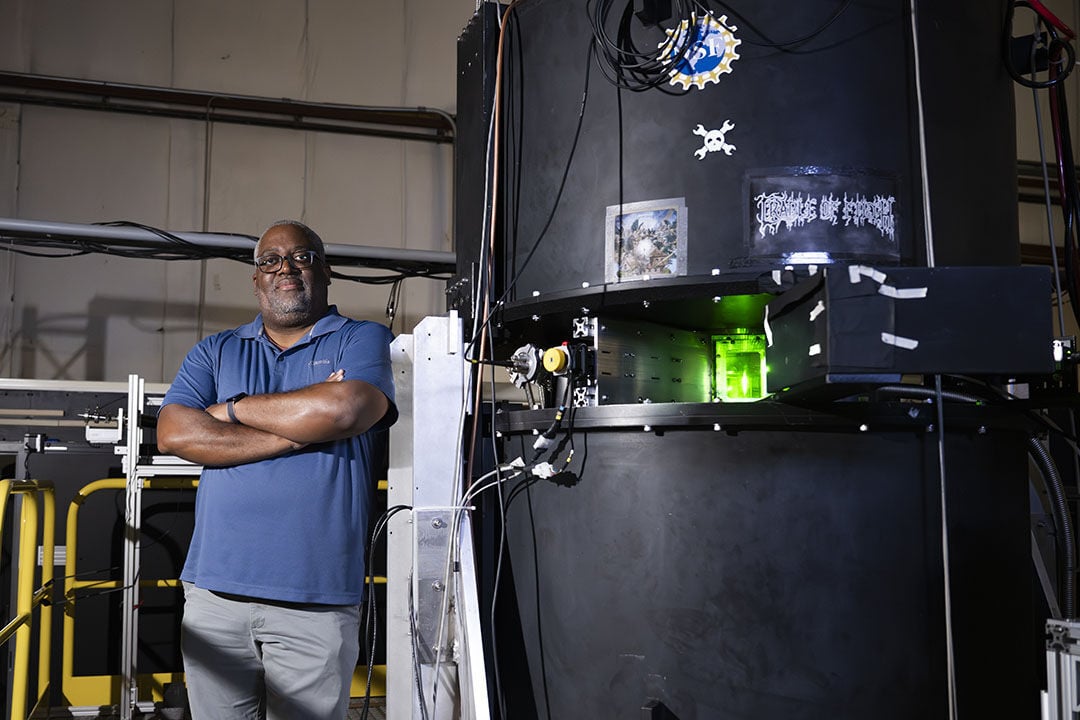
Edward Thomas ’96 handles a lot of duties—serving as dean of the College of Sciences and Mathematics (COSAM), staying current on research trends and solving complex physics equations with grad students. But perhaps his most unique role is leading Auburn’s Magnetized Dusty Plasma Experiment.
A superconducting magnet system that at its peak is 80,000 times stronger than the earth’s magnetic field, it’s one of only six operating around the world—and the only in the U.S.—and aids advanced research on topics like futuristic manufacturing and planetary evolution.
People are also reading…
But without Thomas’ guidance and determination, the Magnetized Dusty Plasma Experiment (MDPX) might have remained a distant dream.
From island to Auburn
Growing up on the island of St. Thomas, where most careers tended toward tourism, Thomas can pinpoint when his interest in science became a full-fledged passion.
One unforgettable summer his uncle, Dr. Ambrose Jearld, a marine biologist at the Woods Hole Oceanographic Institute, deputized him as a lab assistant and took him to work. While these scientists might have been college students in jeans and T-shirts, their enthusiasm for their research was contagious.
“At a really formative moment, I got to spend three months with people doing on-the-ground science and just loving what they were doing,” recalled Thomas. “If there was any moment where I felt, ‘This is what I want to be doing,’ that would have been it.”
As a college student captivated by advances in fusion energy, Thomas earned his bachelor’s from the Florida Institute of Technology in 1989 and his master’s from MIT in 1993. Then, while a doctoral candidate at Auburn studying fusion energy, the discovery in 1994 of the plasma crystal transformed the field of dusty plasma research into an active area of laboratory research.
After graduating Auburn in 1996 and joining Fisk University as an assistant professor, his interests in plasma transport—how particles move in plasmas—serendipitously aligned with questions about transport in this emerging field of plasma physics.
Returning to Auburn in 2000 as an assistant professor in the Department of Physics, he had a vision for executing the experiment on a much grander scale.
What is plasma physics?
Plasma physics may evoke the distant future, but it is already a critical element of modern manufacturing.
In layman’s terms, plasma is created by pumping a chamber full of a neutral gas—like steam—with enough energy to separate electrons from atoms, creating a “soup” of freely flowing positive ions and negative electrons. In a dusty plasma experiment, dust grains placed into the plasma become charged by collecting the ions and electrons. The dust can be directly and indirectly manipulated around the chamber through electric and magnetic forces.
Modern microchips utilize wires so small they can be measured in literal atoms, so dust grains produced as a by-product of the manufacturing process can have the impact on a chip the equivalent of a boulder landing on an ant. The ultimate goal of this work is to find ways to actively control and move these small particles safely in a plasma.
What we went through was the scientific process—pitch your ideas, get your criticism, fix your hypothesis and revise the idea.
When asked at a 2008 American Physical Society Plasma Physics conference where the field of dusty plasmas should head next, Thomas, along with collaborators Bob Merlino (University of Iowa) and Marlene Rosenberg (University of California-San Diego), suggested building a large, multi-user magnetized experiment. Of their three universities, Auburn had the most available space, so it fell to Thomas (“just a lowly faculty member at that point”) to marshal support for the project.
“I remember the first time I pitched the idea to the community, it was [like] a lead balloon. Half of my colleagues went, ‘That’s insane. You’re not going to be able to build a machine like this.’”
For two years Thomas tirelessly presented their ongoing work and previewed where they would go next. With every critique they would revise their pitch, acknowledging challenges while exploring solutions. Finally, after their first proposal was derailed by a detail so subtle only a few worldwide could recognize it, their second was approved with amazing reviews.
“[That diligence] made the project infinitely better. What we went through was the scientific process—pitch your ideas, get your criticism, fix your hypothesis and revise the idea.”
An open-door laboratory
In 2011 Auburn received a $2.3 million grant for the project, at the time the largest major research instrumentation ever awarded in Alabama, and the MDPX began work in 2014 with an open-door policy where people outside Auburn—other universities, national labs and companies—can use it for a variety of experiments.
“We very deliberately have operated in a mode where it’s a community resource, and we do everything that we can so that as many members of the community can come here and run their experiments on it,” said Thomas, who was named dean of COSAM in 2023.
Today Auburn has per capita one of the largest plasma physics research groups in the country. Nearly 40 faculty members, postdocs and graduate students interact with a broad range of industries and professional scientists, advancing dust particle research that could affect the design of astronaut suits and even the future of space travel.
When Auburn hosts its reunion night at the American Physical Society’s annual conference, adds Thomas, there’s enough attendees to fill a whole restaurant.
“Auburn has been remarkably supportive of this idea that we’ve kept pushing for 30 years. At the end of the day, yeah, it was sometimes a struggle, but once we were able to demonstrate that we could be successful, the university’s always been behind it.”