

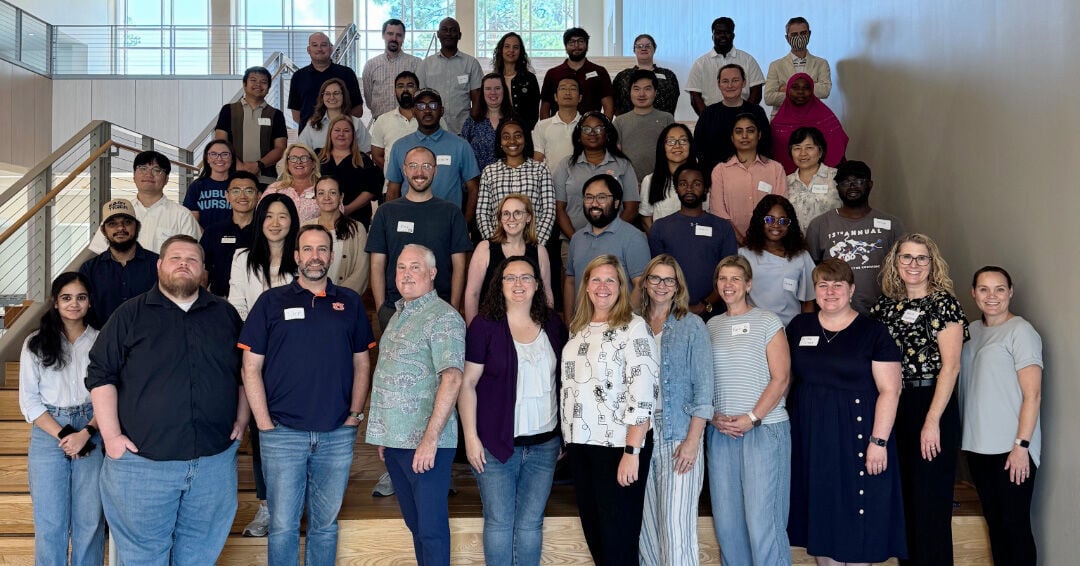
The Biggio Center for the Enhancement of Teaching and Learning (Biggio Center) hosted more than 80 Auburn University faculty members, postdoctoral scholars and graduate teaching assistants for the Auburn University Summer STEM Institute (AUSSI), a week-long professional development program that equips STEM instructors with evidence-based, student-centered teaching strategies.
Participants explored how students learn in STEM disciplines, practiced active learning and backward course design, and developed practical strategies they can apply in their own classrooms. This year's AUSSI theme, Indiana Jones, encouraged participants to approach teaching with curiosity, creativity and a spirit of discovery while creating engaging classroom experiences.
The program concluded with a keynote presentation by Todd Zakrajsek, who challenged participants to rethink teaching by shifting the focus from delivering content to creating meaningful learning experiences for individual students.
People are also reading…
"We're given classes to teach, but our job is to teach individuals," Zakrajsek said.
Throughout the keynote, Zakrajsek emphasized that students bring different backgrounds, learning preferences, motivations, confidence levels and life experiences into the classroom. He encouraged participants to intentionally design learning experiences that actively engage students and create opportunities for every learner to succeed.
Participants applied those ideas by developing "tidbits," short active-learning activities designed to teach a single concept using student-centered instruction. Working in disciplinary teams, they designed, presented and refined activities they can adapt for their own courses.
"Opening AUSSI up to all STEM faculty at Auburn generated so many innovative, interdisciplinary teaching approaches and helped participants strengthen their communities across campus," said Lindsay Doukopoulos, associate director of the Biggio Center. "One theme that kept coming up was the surprise that no matter our discipline, we share the same teaching challenges."
The resulting activities showcased how faculty from across STEM disciplines transformed those shared challenges into engaging, student-centered activities.
Raiders of the lost energy
Inspired by this year's Indiana Jones theme, the physics group created "Raiders of the Lost Energy," an activity exploring the principle of conservation of energy. Using a familiar movie scenario, students analyzed which object Indiana Jones could most likely outrun while applying concepts of energy transfer and motion. The activity demonstrated how connecting course concepts to popular culture can make physics more engaging while encouraging students to apply scientific reasoning to real-world questions.
Wild-AUSSI
The forestry group developed "Wild-AUSSI," an activity focused on wildlife assessment and management. Students examined groups of animals and determined where they would most likely be found across Alabama based on habitat preferences. They were then challenged to consider what influences those preferences and how environmental factors affect species survival, helping students understand the relationship between habitat and wildlife distribution.
Osmosis Jones and the Temple of Tonicity
The health and biological sciences group created "Osmosis Jones and the Temple of Tonicity," an interactive activity demonstrating diffusion and tonicity through role-playing. Student volunteers represented the movement of water as human red blood cells were placed in isotonic, hypertonic and hypotonic solutions, helping visualize how water moves across a semipermeable membrane relative to solute concentrations. Students then applied those concepts to clinical scenarios involving intravenous solutions, connecting foundational biology concepts to healthcare practice.
Engineering: Understanding generative AI
The engineering group developed a tidbit introducing students to the fundamentals of generative artificial intelligence. Students explored how generative AI tools use training data and probability to generate text, helping them understand why responses can sometimes be accurate, contradictory or entirely fabricated. The activity encouraged students to think critically about how generative AI works and evaluate the strengths and limitations of AI-generated content.
Optimization: Finding the best way out of many
The mathematics and statistics group created "Optimization: Finding the Best Way out of Many" to introduce optimization concepts in a Calculus I course. Students used equal-sized sheets of paper to build open-top boxes designed to hold the greatest amount of popcorn, discovering through experimentation the tradeoff between box height and base size. After comparing the amount of popcorn each box held, students used an online simulation to model the volume of each box with a polynomial function. The activity demonstrated how the maximum volume corresponds to the highest point on the graph, providing a practical introduction to optimization and motivating the use of derivatives to identify the maximum value.
Dr. Jones' agricultural response team
The agriculture group designed a scenario-based, team-building activity introducing students to the idea that solving major plant-related challenges requires collaborative, interdisciplinary teams. Students assumed the role of Dr. Jones and selected four response team members to address challenges such as modifying flower color for graduation or managing a coffee beetle infestation. By making strategic decisions based on each team member's expertise and background, the activity emphasized systems thinking, rapid decision-making, collaboration and the ability to justify team composition when addressing complex agricultural and plant health challenges.
In the end
The tidbits developed throughout the week reflected the central message of Zakrajsek's keynote: effective teaching begins with designing learning experiences for individual students rather than simply delivering content. From explaining the probabilistic nature of generative AI and modeling covalent bonds to solving agricultural challenges through interdisciplinary collaboration, participants demonstrated innovative, student-centered approaches that can be adapted across STEM disciplines. As participants return to their classrooms, they bring new strategies, stronger interdisciplinary connections and a shared commitment to creating engaging learning environments for every student.
Disclaimer: AUSSI is part of a research collaboration between the Biggio Center and the College of Sciences and Mathematics, partially funded by the National Science Foundation Improving Undergraduate STEM Education (IUSE) grant IDEALS (NSF award #2236315). Stephanie Shepherd, associate professor in the Department of Geosciences, serves as principal investigator. Melinda Lanius, Karen McNeal and Lindsay Doukopoulos serve as co-principal investigators. The AUSSI program is co-led by Stephanie Shepherd, Rachel Prado and Lindsay Doukopoulos. Melinda Lanius leads the IDEALS research component.